

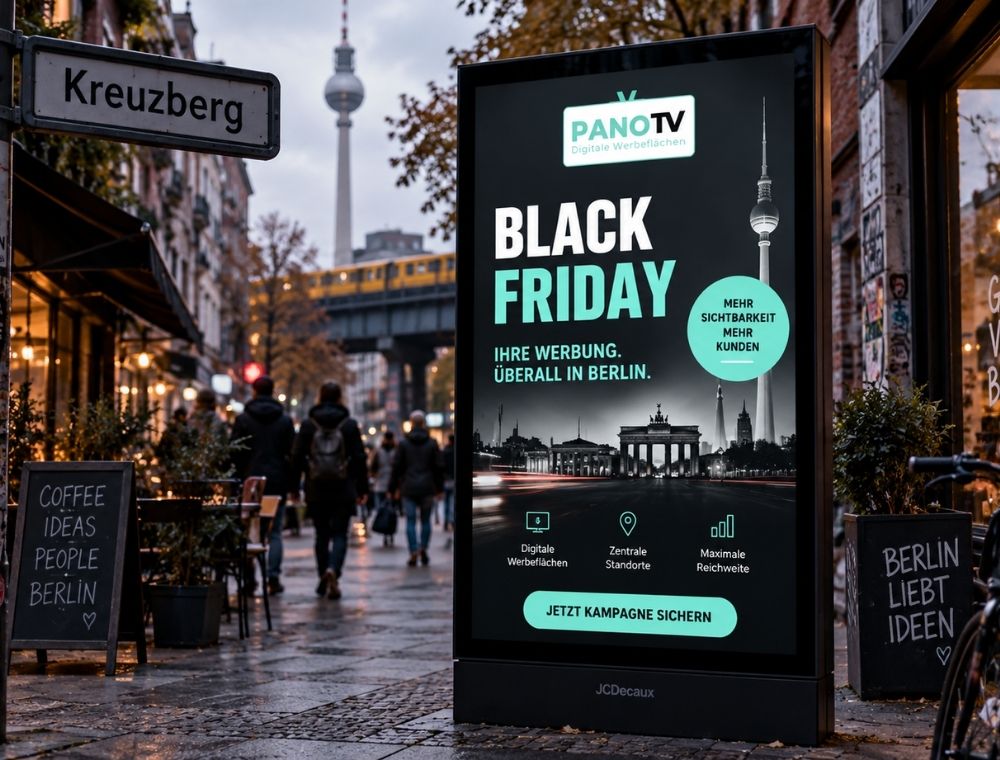
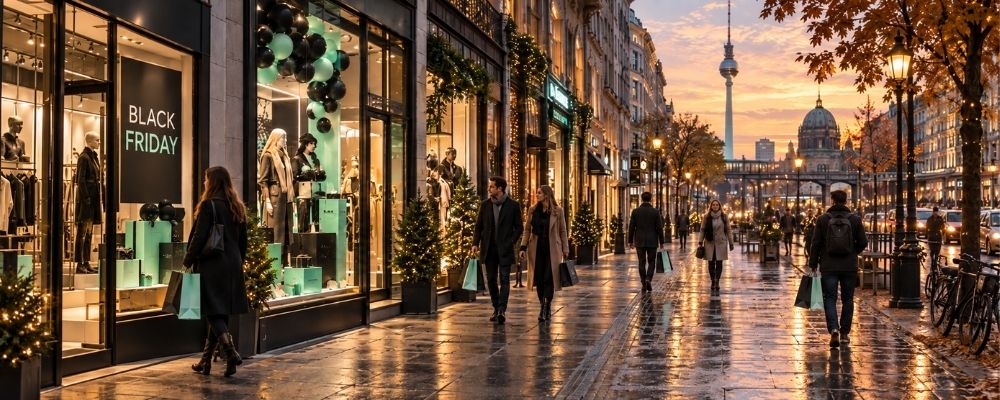
Black Friday has long since stopped being a topic for large online shops alone. Local businesses also use this shopping day to draw new customers’ attention to their offers. The challenge, however, is not to become visible only once the flood of discounts has already begun.
Anyone who announces an offer early creates recognition. People may see the message while shopping, in a café or during an appointment at the barbershop. When they come across the offer again later, they have already heard the name of the business. For smaller retailers in the Kiez in particular, this repeated visibility is worth more than a particularly loud advert on Black Friday itself.
Why the shopping day alone can be too late for local offers
On Black Friday, many offers compete for attention at the same time. Large retailers advertise through newsletters, social networks and platforms with big budgets. A local business neither can nor needs to compete with that. It should, however, avoid drawing attention to its offer for the first time only on the shopping day itself.
A discount works better when it does not come as a complete surprise. Anyone who announces a promotion a few days or weeks in advance gives interested customers time to remember the offer. A restaurant might want to advertise a special menu, for example, or a hair salon a voucher offer.
What makes a good local Black Friday offer?
Not every price reduction is automatically a convincing offer. Much more important than a good price is that people understand at a glance what the offer is about.
A good local offer answers three questions:
- What is on offer?
- Who is it for?
- How long is the offer available?
An example:
A Turkish supermarket in the Kiez wants to draw its customers’ attention to selected products for the Black Friday weekend. It does not announce a general discount on the entire range, but on a clearly defined product area.
„Black Friday at [name of the shop]: 20 per cent off Turkish sweets – Friday to Sunday, only at our Neukölln branch.“
At a glance it is clear which offer applies and when the promotion ends.
The clearer the message, the more likely it is to stick. The screen is there to spark interest. Customers find out the detailed information later, in the shop itself.
The right timing: how to structure the campaign
For local retailers, a short campaign with several stages usually makes more sense than a single spot on Friday morning. The advertising can build up step by step:
- About three weeks before: The campaign announces that an offer will follow on Black Friday. At this stage it is mainly about the name of the shop and a first wave of attention.
- In the week before: The specific offer becomes visible. At this point the benefit and the promotion period should be clearly stated so that interested customers can plan ahead.
- Shortly before and during the promotion day: The message is reduced to the essentials: offer, period and address or branch. Anyone who has already seen the spot will recognise it immediately.
This careful planning also helps later on when the campaign is designed. The basic visual stays the same throughout. Only the text or the offer is adjusted. The recognition effect builds up without the spot having to be announced all over again each time.
Why is the location of the advertising so important?
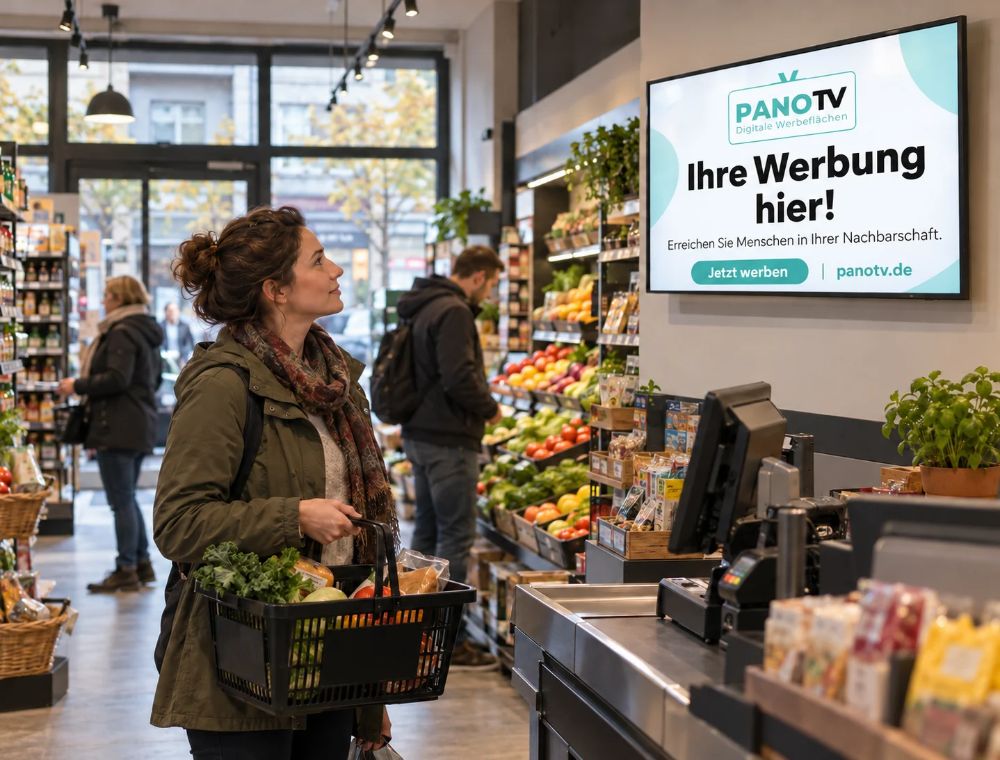
Advertising is not perceived in the same way in every place. In a supermarket, people come across offers while they are shopping and comparing prices anyway. In a café, barbershop or cultural association, on the other hand, there is more time to look at a screen and perhaps even to start a conversation about the content in a familiar environment.
The location influences not only the reach, but also the way people are addressed. An offer from a nearby shop works particularly well when it appears exactly where potential customers are out and about every day. The same applies to advertising in community spaces. This is not about defining people by their origin, but about taking their everyday reality and their surroundings seriously.
How can an advertising spot stay understandable on screen?
Screen advertising is usually only seen for a few seconds. That is why a spot needs one clear main message. A decorative image can attract attention, but it must not overshadow the information.
These elements should be easy to recognise at a glance:
- a specific offer or a clearly understandable benefit
- the period of the promotion
- the name of the shop or the brand
- a way to find the offer (e.g. the address, a branch or a QR code)
Does a QR code make sense in the offer?
A QR code only makes sense if the step that follows it is genuinely simple. It can lead straight to an offer page, an appointment booking or a map showing the location. If it leads to a cluttered homepage instead, it wastes valuable potential. A clearly legible typeface is just as important. Small text and long explanations do not work on a display.
From the offer to repeat visits: what matters after Black Friday?
Black Friday is an ideal occasion for bringing new people into a shop. Local businesses can use this effect to build up a customer base over the long term. What matters now is that shops make use of the time after the promotion day and do not become invisible again afterwards. It therefore makes sense to develop the campaign further afterwards. Instead of the discount, they can now communicate regular services, seasonal news or special offers.
How PanoTV supports local Black Friday campaigns
PanoTV places digital advertising spots at locations where people from the respective communities go about their everyday lives. These include supermarkets, cafés, barbershops and cultural associations, among others. For a Black Friday campaign, playout can therefore start easily before the actual date and then be adjusted around the promotion day without much effort.
The campaign is managed centrally. Retailers can first announce their message, then make it more specific, and switch back to other content after the Black Friday weekend. In this way they build a presence that has a lasting effect and can be realigned again and again, for example around seasonal offers.